China will search for a second Earth
This major scientific program was officially announced today, November 24, 2025, at the press conference on the latest highlights of the Space Science Leading Project.
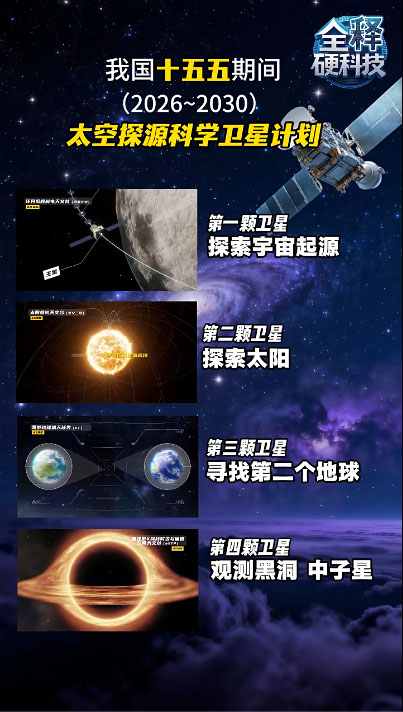
The space exploration science satellite program, which will be implemented over the next five years, includes an exoplanet survey satellite specifically dedicated to finding an 'Earth 2.0'. The plan involves launching four satellites, focusing on major frontier issues such as the origin of the universe, the origin of space weather, and the origin of life, aiming to achieve new breakthroughs in the detection of exoplanets similar to Earth.
The first satellite is the Hongmeng Project, designed to listen to the 'cries' of the universe in its 'infancy.' It is a low-frequency radio telescope array consisting of 10 satellites, which will collectively fly to the far side of the Moon—a quiet 'radio studio' in the cosmos that can shield all noise from Earth and the Sun, enabling the capture of faint signals from the depths of the universe. It will help us unravel the mysteries of the chaotic era lasting several hundred million years before the first stars appeared after the Big Bang.
The second satellite is the Kuafu-2, nicknamed 'Staring at the Sun.' It will orbit the Sun's polar regions for the first time internationally, like a high-altitude photographer directly gazing at the Sun's 'North Pole' and 'South Pole.' Hidden there are the ultimate secrets of solar magnetic activity. Understanding it will allow us to predict solar storms earlier and better comprehend the relationship between our human-inhabited Earth and the Sun.
The third satellite is the Exoplanet Survey Satellite, tasked with 'finding a new home for humanity.' Is Earth lonely? Are there other habitable planets in the universe? This satellite will patrol the galaxy, specifically searching for 'Earth 2.0'—planets roughly the size of Earth located in habitable zones. Perhaps in the not-too-distant future, it will point us toward a second dream家园 that humanity has longed for.
The fourth satellite is the eXTP, a 'Space Observatory' flying outside Earth's atmosphere. Its mission is to observe the 'extreme forbidden zones' of the universe, such as the event horizon of black holes and the scorching surfaces of neutron stars. In those regions, gravity is strong enough to tear apart the fabric of spacetime, and magnetic field intensity reaches trillions of times that of Earth. eXTP acts like a top physicist, delving into these extreme laboratories to test Einstein's predictions, explore the boundaries of physics, and conduct cosmic-scale experiments that cannot be achieved on Earth.
From the birth of the universe to the origin of life, these satellites roaming among the stars will write China's answers to humanity's ultimate exploration.